The 6 Best Home Improvement Loans | 2026

[placeholder name=”lightbox-click-table-placeholder”]
Key Takeaways
- Choose your home improvement loan based on your project size, timeline, and credit profile.
- Home equity loans and cash-out refinances typically offer lower rates but require sufficient equity.
- FHA 203(k) loans are ideal for fixer-uppers, while personal loans and credit cards suit smaller projects.
Ready to tackle those home improvements? Whether it’s a small update or a major makeover, there are plenty of loan options out there to help fund your project.
In this article, we’ll break down the six main types of home improvement loans so you can easily find the one that suits your needs best.
In this article (Skip to…)
- What are the different types of home improvement loans?
- Best types of home improvement loans
- How to fund your home improvements quiz
- Additional resources
- Home improvement loans FAQ
What are the different types of home improvement loans?
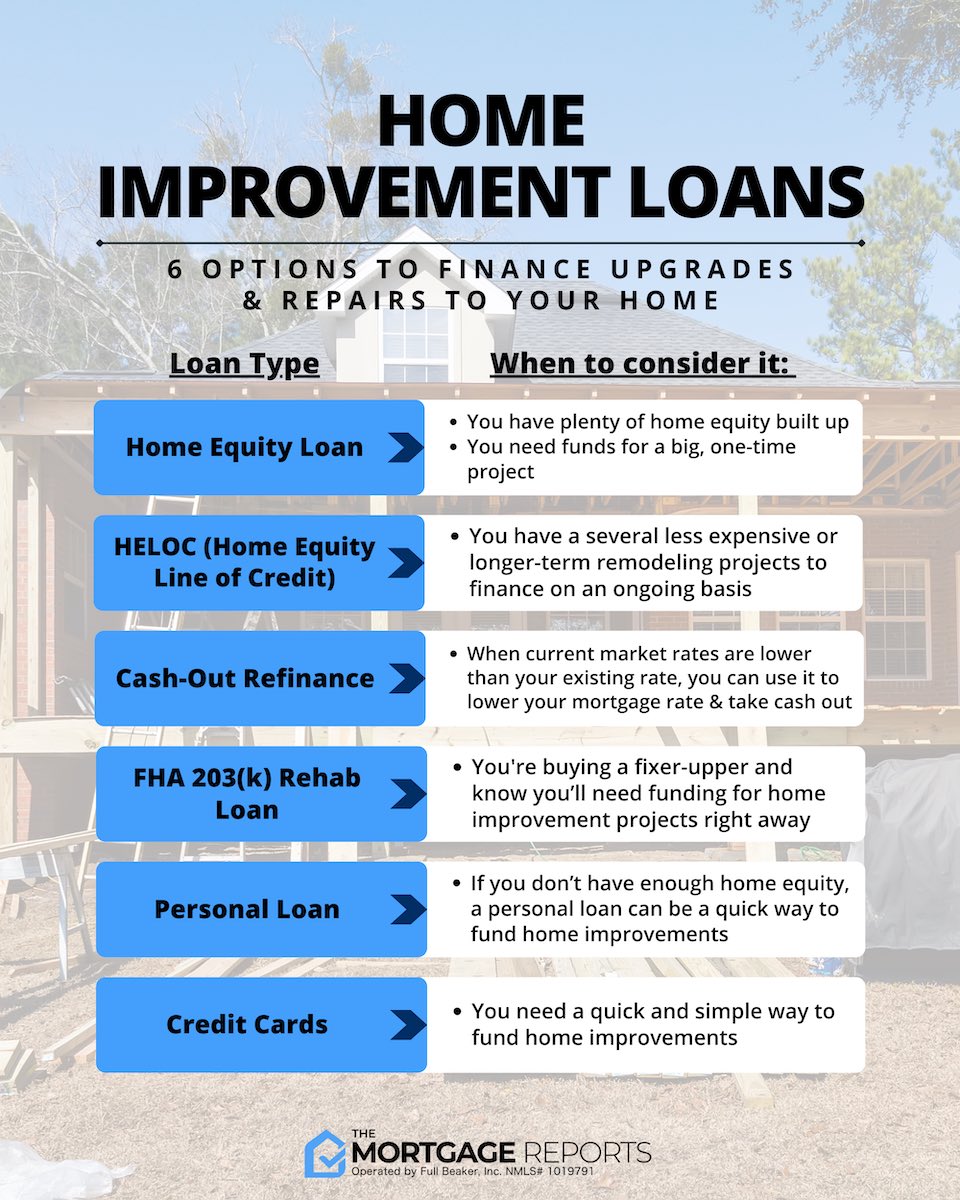
If you’re planning home improvements and weighing your financing options, here’s a quick breakdown of the most common loan types.
Check home improvement loan options and rates. Start here (Mar 7th, 2026)Different types of home improvement loans
- Home Equity Loan: A fixed-rate lump sum borrowed against your home’s equity. Best for large, one-time projects with predictable costs.
- HELOC (Home Equity Line of Credit): A revolving credit line based on your equity. You borrow as needed, making it ideal for ongoing or phased renovations.
- Cash-Out Refinance: Replaces your current mortgage with a larger one, letting you take out the difference in cash. Helpful if you want to tap equity and possibly secure a better rate.
- FHA 203(k) Loan: Government-backed loan that combines the cost of buying (or refinancing) a home with renovation expenses. Offers a low down payment and flexible credit requirements.
- Personal Loan: A fast, unsecured loan that doesn’t require home equity. Good for smaller projects or when you need money quickly.
- Credit Card: Offers immediate access to funds for minor upgrades or repairs. May work well if you qualify for a 0% introductory APR period.
Home improvement loan options compared
| Loan Type | Approval Time | Min Credit Score | Loan Amount Range | Max LTV / Collateral | Interest Rate Type | Flexible Use |
|---|---|---|---|---|---|---|
| HELOC | 2–6 weeks | 620+ | Up to 85% home value | Secured by home equity | Variable | Yes |
| Home Equity Loan | 2–6 weeks | 620+ | Up to 80–90% home value | Secured by home equity | Fixed | Yes |
| FHA 203(k) Loan | 4–8 weeks | 580+ | $5,000 – $50,000+ | Secured by home | Fixed | Restricted |
| Cash-Out Refinance | 4–6 weeks | 620+ | Up to 80–90% home value | Secured by home | Fixed or variable | Yes |
| Personal Loan | 1–7 days | 620+ | $1,000 – $50,000+ | Unsecured (no collateral) | Fixed | Yes |
| Credit Card | Minutes to hours | 620+ | Varies, typically <$10K | Unsecured (no collateral) | Variable | Yes |
Best types of home improvement loans
Now that you’ve seen a quick summary of the different options, let’s take a closer look at each loan type. Understanding how they work, their pros and cons, and who they’re best for can help you make a more confident financing decision.
1. Home equity loan
A home equity loan lets you borrow against the equity you’ve built in your home, which is the home’s value minus your remaining mortgage balance.
Check your home equity loan options. Start here (Mar 7th, 2026)Unlike a cash-out refinance, it doesn’t replace your current mortgage. You’ll keep making payments on your existing loan, plus a separate payment for the new home equity loan.
Home equity loan quick facts
| Loan amount | 80% to 85% of your home’s appraised value minus current mortgage balance |
| Funding timeline | 2 to 6 weeks |
| Repayment term | 5 to 30 years, with 10 to 15 years being most common |
| Requirements | 15% to 20% equity, a 620 credit score or higher, a max DTI of 45%, and sufficient income |
| Project type | Major remodels, fixed-cost projects |
| Ideal candidate | Established homeowner, strong equity, prefers fixed payments |
Key Benefits
- One of the most affordable equity options: Home equity loans are typically cheaper than cash-out refinancing, with lower interest rates and closing costs.
- Fixed interest rates: Enjoy predictable monthly payments and protection from rate hikes—ideal for long-term budgeting.
- Lump sum funding: Get the full loan amount upfront, perfect for major expenses like renovations or large purchases.
- Potential tax benefits: Interest may be tax-deductible when the loan is used for qualified home improvements.
- No spending restrictions: Use the funds however you like, from home upgrades to education costs or even a second home down payment.
2. HELOC (home equity line of credit)
A home equity line of credit (HELOC) is another great way to borrow from your home equity without refinancing. A HELOC is similar to a home equity loan, but it works more like a credit card. You can borrow from it up to a preapproved limit, pay it back, and borrow from it again.
Check your HELOC options. Start here (Mar 7th, 2026)HELOC quick facts
| Loan amount | 80% to 85% of your home’s appraised value minus current mortgage balance |
| Funding timeline | 2 to 6 weeks |
| Repayment term | 10 to 20 years |
| Requirements | 15% to 20% equity, a 620 credit score or higher, a max DTI of 45%, and sufficient income |
| Project type | Phased, ongoing, variable-cost projects |
| Ideal candidate | Homeowner with equity, good credit, flexible |
Key Benefits
- Borrowing flexibility: Withdraw and repay funds as needed within the draw period.
- Lower interest rates: Secured by home equity, they offer more favorable rates.
- Interest-only payments: Pay interest only on the amount borrowed during the draw period (not the full credit limit).
- Interest deductibility: Interest paid on the loan may be tax-deductible if used for home improvements.
- Lower costs: Typically, less expensive than cash-out refinancing, with lower closing costs and quicker processing.
- No usage restrictions: Use the funds for any purpose, from home improvements to education.
- Efficiency: Faster to set up compared to alternatives, providing quick access to funds.
Quick Fact
According to the 2025 Remodeling Impact Report from the National Association of Realtors, 54% of homeowners used a home equity loan or line of credit (HELOC) to fund their latest remodel.
3. Cash-out refinance
Another popular way to get money for a home remodeling project is a cash-out refinance. With this option, you refinance to a new mortgage loan with a bigger balance than what you currently owe. Then you pay off your existing mortgage and keep the remaining cash.
Check your eligibility for a cash-out refinance. Start here (Mar 7th, 2026)The money you receive from a cash-out refinance comes from your home equity. It can be used to fund home improvements, although there are no rules that say cash-out funds must be used for this loan purpose.
Cash-out refinance quick facts
| Loan amount | Up to 80% of your home’s appraised value minus your current mortgage balance |
| Funding timeline | 4 to 6 weeks |
| Repayment term | 15 to 30 years (based on new mortgage term) |
| Requirements | At least 20% equity, a credit score of 620 or higher, stable income, and acceptable debt-to-income ratio |
| Project type | Large, one-time, fixed-cost renovations |
| Ideal candidate | Homeowner with strong equity, stable finances, and a higher-rate existing mortgage they can refinance |
Key Benefits
- Access to large funds: Tap your home equity to cover big projects or full remodels.
- Potential for lower rate: If current rates are better, you could save on interest while renovating.
- One loan, one payment: Keep things simple with a single monthly mortgage payment.
- Flexible use of cash: Use funds for renovations, debt payoff, or other financial goals.
- Option to adjust loan term: Shorten your payoff timeline or reset for a lower monthly payment.
4. FHA 203(k) rehab loan
An FHA 203(k) rehab loan lets you finance your home purchase and renovation costs with a single mortgage, no need for two separate loans or double closing costs.
Check your eligibility for an FHA 203(k) loan. Start here (Mar 7th, 2026)It’s a great option if you’re buying a fixer-upper and need funds for improvements right away. Backed by the government, it also offers perks like a low down payment and more flexible credit requirements.
FHA 203(k) refinance quick facts
| Loan amount | Up to 110% of the home’s projected value after renovations (subject to FHA limits) |
| Funding timeline | 4 to 8 weeks |
| Repayment term | 15 to 30 years |
| Requirements | 580+ credit score, 3.5% down payment, must be used for a primary residence |
| Project type | Necessary or approved improvements (e.g., structural repairs, modernization); luxury upgrades not allowed |
| Ideal candidate | Buyers purchasing a fixer-upper who want to finance renovations as part of the mortgage |
Key Benefits
- One loan for purchase and renovation: Combines the home price and improvement costs into a single mortgage
- Lower upfront costs: Only one set of closing costs, which can reduce your out-of-pocket expenses
- Low down payment: Just 3.5% down with a credit score of 580 or higher
- Flexible credit requirements: FHA backing makes it easier to qualify with less-than-perfect credit
- Higher financing potential: Borrow up to 110% of the home’s projected post-renovation value (subject to FHA limits)
- Covers a wide range of repairs: From structural updates to modernization and energy improvements
- Opportunity to build equity quickly: Renovations can boost home value soon after purchase
- Ideal for fixer-uppers: Helps buyers afford homes that need work and transform them into move-in ready spaces
Standard vs. Limited FHA 203(k): What’s the Difference?
The Standard 203(k) loan is for major or structural renovations requiring a consultant, while the Limited 203(k) covers smaller, non-structural repairs and improvements up to $35,000 with a simpler process.
5. Personal loan
If you don’t have enough home equity to borrow from, a personal loan is another way to finance home improvements.
Because a personal loan is unsecured, you won’t use your home as collateral. That means these loans can be obtained much faster than HELOCs or home equity lines of credit. In some cases, you may be able to get loan funding on the next business day or even same-day funding.
Personal loan quick facts
| Loan amount | Typically $1,000 to $50,000+ (varies by lender) |
| Funding timeline | 1 to 7 days (often faster for online lenders) |
| Repayment term | Usually 2 to 7 years |
| Requirements | Minimum credit score typically 620+, proof of income, and good debt-to-income ratio |
| Project type | Any home improvement project—no restrictions on use |
| Ideal candidate | Borrowers seeking quick, unsecured funds for small to medium home improvement projects without using home equity |
Key Benefits
- No collateral required: Unsecured loan, so your home isn’t at risk
- Fast approval and funding: Often funded within days, ideal for quick projects
- Flexible use of funds: Use the money for any home improvement, big or small
- Fixed interest rates: Predictable monthly payments without surprises
- No restrictions on project type: Unlike specialized loans, personal loans cover anything from minor repairs to major upgrades
- Simpler application process: Less paperwork and fewer qualification hurdles than home equity loans
- Ideal for smaller projects: Great if you don’t want to tap into home equity or deal with long-term mortgages
6. Credit cards
You could always finance some or all of your remodeling cost with plastic, too. This is the quickest and simplest financing option for a home improvement project.
But because home improvements often cost tens of thousands of dollars, you need to be approved for a higher credit limit. Or, you’ll need to use two or more credit cards. Plus, you’ll likely pay interest rates that are much higher than those charged by home improvement loans.
Credit cards quick facts
| Loan amount | Varies by credit limit; typically up to $10,000 or more |
| Funding timeline | Minutes to hours |
| Repayment term | Revolving credit—minimum monthly payments; can pay over months or pay in full |
| Requirements | Credit approval based on credit score, income, and credit history |
| Project type | Any home improvement expense, small or large |
| Ideal candidate | Borrowers needing fast, flexible access to funds, who can manage revolving credit responsibly |
Key Benefits
- Immediate access to funds: Great for small, urgent repairs or purchases
- Convenient and easy to use: No application process if you already have a card
- Potential rewards and cashback: Earn points, miles, or cashback on your spending
- Flexible repayment options: Pay off the balance over time or in full to avoid interest
- No collateral required: Unsecured borrowing without risking your home
- Widely accepted: Use for materials, labor, or online purchases anywhere cards are accepted
- Introductory 0% APR offers: Some cards offer 0% interest for a promotional period, reducing borrowing costs
Check your home improvement loan options. Start here (Mar 7th, 2026)
Additional resources
Looking for more information? We’ve created additional articles that explore specific options for people who may be seeking renovation financing. For a deeper dive, be sure to check out the resources below.
How to Get a Home Improvement Loan
Using a HELOC for Home Improvements
How to Use a Personal Loan for Home Improvement
How to Finance a Home Renovation Without Equity
Home improvement loans FAQ
Get started on your home improvement loan. Start here (Mar 7th, 2026)The best loan for home improvements depends on your finances. If you have a lot of equity in your home, a HELOC or home equity loan might be best. Or, you might use a cash-out refinance for home improvements if you can also lower your interest rate or shorten your current loan term. Those without equity or refinance options might use a personal loan or credit cards to fund home improvements instead.
That depends. We’d recommend looking at your options for a refinance or home equity-based loan before using a personal loan for home improvements. That’s because interest rates on personal loans are often much higher. But if you don’t have a lot of equity to borrow from, using a personal loan for home improvements might be the right move.
The credit score requirements for a home improvement loan depend on the loan type. With an FHA 203(k) rehab loan, you likely need a 620 credit score or higher. Cash-out refinancing typically requires at least 620. If you use a HELOC or home equity loan for home improvements, you’ll need a FICO score of 680-700 or higher. For a personal loan or credit card, aim for a score in the low-to-mid 700s. These have higher interest rates than home improvement loans, but a higher credit score will help lower your rate.
If you’re buying a fixer-upper or renovating an older home, the best renovation loan might be the FHA 203(k) mortgage. The 203(k) rehab loan lets you finance (or refinance) the home and renovation costs into a single loan, so you avoid paying double closing costs and interest rates. If your home is newer or higher-value, the best renovation loan is often a cash-out refinance. This lets you tap the equity in your current home — and you could refinance into a lower mortgage rate at the same time.
Home improvement loans are generally not tax-deductible. However, if you finance your home improvement using a refinance or home equity loan, some of the costs might be tax-deductible.
Disclaimer: The Mortgage Reports does not provide tax advice. Be sure to consult a tax professional for any questions about your taxes.
Shop around for your best home improvement loan
As with anything in life, it pays to compare all your options. So don’t just settle on the first loan offer you find. Compare loan types, rates, and terms carefully to find the best loan for home improvements.
Verify your new rate (Mar 7th, 2026)